Showing posts with label World Heritage Site. Show all posts

Friday, March 29, 2013

The First Impression of Ayutthaya

I didn't know anything about Wat Yai Chai Mongkhon before I went there. I had a simple guide book in which this temple was introduced with a large Reclining Buddha. I thought there was only a Reclining Buddha, I thought this was  a common spot as the same as others, I though... I shouldn't think because I did't know anything about Thailand temples. So, I thought wrong.

Actually, Wat Yai Chai Mongkhon is the first really temple and first ruin I visited at Thailan. I even didn't prepared well for it. It is a quiet place far from railway station. It took me almost 20 minutes to get there by bicycle. The light of setting sun was soft and fluid, all the things was covered a golden color, including structures, birds, cats, grass and me. The great Reclining Buddha was there, but it wasn't the point. I saw many tower standing in the flowing golden light, lines of Buddhas and plumerias falling from the trees. The main building is very tall, and,  to my surprise, visitors can clime up it. I even encountered a dog on it.

Everything was great at that time. I was impressed. 


Friday, December 7, 2012

Jongmyo & Changdeokgung

Koreans are proud of their culture very much, I think.

A policy, visitors must join a tour with a guide, is made by Jongmyo these years. I thought it was aimed at protecting the structures, but I might be wrong. 

To match the time, I joined a Japanese tour. The guide was very good at Japanese, and likely knew Japan a lot. I guessed it would be boring if I visited Jongmyo alone, because I learned many things about it from that guide. She said that Jongmyo was listed in the world heritage and rated highly, because every year in May, the posterity of Joseon Dynasty holds the traditional rites. Jongmyo ariginated from China, and could be found in southeast Asia countries. They just remain the structures, while Korean Jongmyo continues holding rites. For that, I got clear why there was a guide. Koreans are doing an effort  to show foreign visitors their culture, that is the point.


Waiting to get in Jongmyo
Main structure of Jongmyo
I visited Changdeokgung, one of the Five Grand Palaces in Joseon Dynasty, and found it resembled the palace in northeast China which also had floors upon the ground and stovepipe outside the house to keep the room warm and resist the cold climate in winter. It is simple nature. I like structures with the original wooden color more than the painting stuffs, though I didn't expect to see them in a palace.


Main gate of Changdeokgung

Injeongieon, Main Hall 
stovepipe

Floor upon the ground

Tuesday, December 4, 2012

Suwon

 Suwon is a small town near Seoul and includes a world heritage Hwaseong Fortress built in 1796 by the King Jeongjo of Joseon who is famous for a drama called with his name, Yi San. 

It took me a long time to get to Suwon from Seoul by subway. The memory about Suwon was wet. It was raining when I arrived there without an umbrella. I didn't take a bus to Hwaseong Fortress. It seemed not far from the station, and I like walking. At first the rain was light. I walked in the street feeling daily life of this town. There were not many tall buildings and people, and a few small supper market beside the road just as China. 


road-side supper market
A GPS leaded me to Hwaseong Fortress, but I set a wrong point that made me to take a curving way. It rained more heavily, and I was lost. It was a road through the hillside, beside that was a pavilion. I decided to have a rest there, pinpoint my location and wait the rain to get lighter. There were three people already there, an old man murmured to himself now and then, and two middle-aged men talked with each other loudly. I was checking maps and GPS to plan a route from then on when one of the middle-aged men spoke to me in Korean. I said " I don't know Korea". He seemed to meet difficult and spoke to the other one. After their short conversation, the man came to me and ask me with English words: "YOU, COME, FROM, WHERE?" "China", I said. "YOU, COME, KOREA, WHY?" I answered him, but he didn't understand. He signal me to come with him. I thought he would show me the way, but he drew an umbrella in the sky. I found the fortress wall when we walked along the prior road. He made me wait among some houses by the road, and turn in anther direction. His house must be near there. After a while, he came back with just ONE umbrella. I was confused what did he mean? Didn't he want to borrow an umbrella to me? I thanked him and asked how could I give back it to him. He ignored my words and asked me to put up the umbrella with him. 

When we walked back to the wall, I told him I was going to get down the hill by showing him a map. But he point the peak of the hill where there was a big bell and then dragged me to go. I was scared and shouted HELP so that he released my arm. I got angry and told him don't follow me, but it didn't work. I had to do something let him go, I thought. There was a ticket booth on the foot of the hill and an old lady was sitting in it. I tried to tell her the issue, but she replied me in Japanese: "All this area is not free"...

 I continued to go toward Haenggung Palace expecting to meet officials but no one. There were another ticket booth in front of Haenggung Palace, and also an old lady who didn't understand me. However, she told me volunteers who could speak foreign languages was at the gate of palace. I moved to a volunteer, a young lady around 30 yeas old, and told her the whole thing. She was very nice, sympathized with me in my trouble and gave me an umbrella. She said something to the man, then he went away.


Haenggung Palace 
I roamed around the palace which is simple and not interesting and felt down. I did want to see the wall. However, since it was a rainy Monday, few visitors came here. I was afraid the man followed me, so I must avoided remote places. And I was tired, physically and mentally.

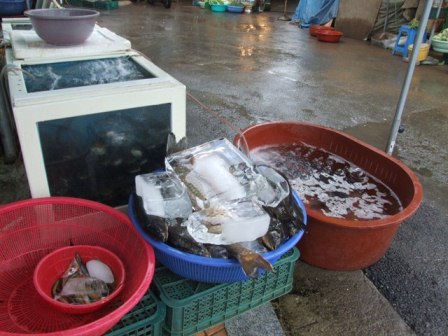
I returned to the station passing by the south gate of the fortress, Paldalmn. Unfortunately, it was in maintenance, I didn't see even a corner of it. Otherwise, luckily, I found a local market and delicious foods: BAOZI and MAHUA. I like local markets. They're funny, close to daily life, and makes me feel nostalgic for childhood. When I was eating baozi with satisfaction, the man who followed me before appeared. It wasn't a coincidence, because I'd told him I wanted to see Paldalmn. He pretended to be surprised and greeted to me happily. But when he saw the umbrella I was putting on, he seemed disappointed and went away. 

It was the last day I stayed in South Korea. I was tired. 


Fortress Wall
Paldalmn in maintenence 
Paldalmn at manhole cover
Baozi shop
Local market


Sunday, December 2, 2012

Bulguksa


It's said that Bulguksa, built in 528, is the oldest temple in Korea. It's also a World Heritage added in 1995 with Seokguram.

I went there by bus with many other visitors. After got off the bus, there was a slope to the temple. Booths of food filled the roadsides, the owners friendly called out to me before I bought their foods. 

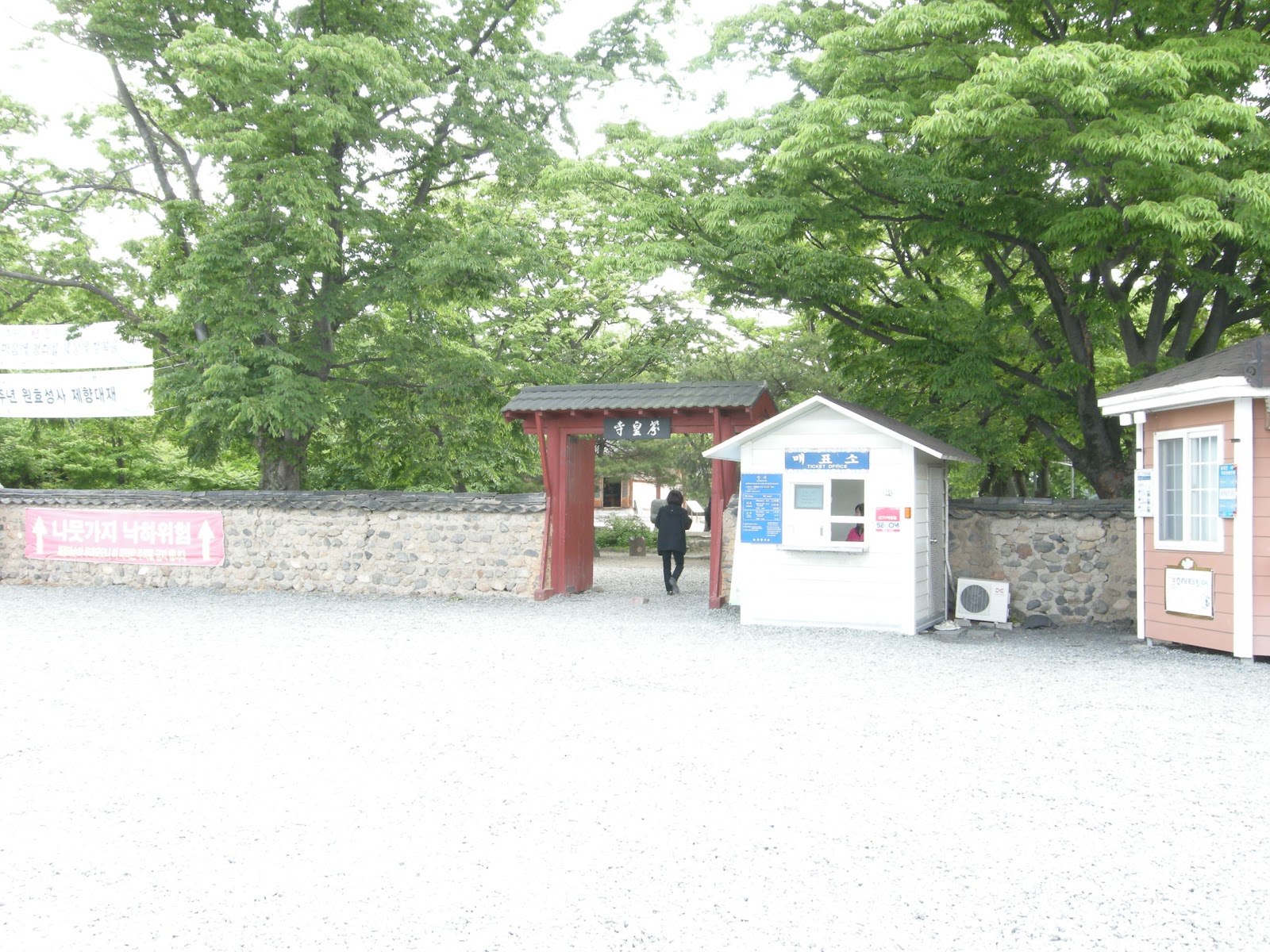
Main gate of Bulguksa
Second gate of Bulguksa
I can't remember much about Bulguksa except the stairs of the entrance. Though they're not used anymore, it's still magnificent. The temple has no glazing colors, and stone materials is light yellow. It's likely another kind of stone different from white marble, a common material used in temple or palace building in China.
Stairs of the entrance
When I felt thirsty, luckily I found a spring. I recognized I was in the mountain where the water was pure. I stored a bottle of it.

Spring
 I had no time to visit Seokguram though it was near Bulguksa. I asked the schedule of the bus bound for Singoguryeo Station in advance and considered I could arrived at the station before the KTX left. But I was wrong. I was so tired that slept in the bus. It seemed the bus went through downtown and picked up many noisy students. I slept and slept until the terminal, Singoguryeo Station. I woke up but still muddled, seeing people were coming out of the station. It meant KTX had left -- only before several minutes. And it also meant I should wait for the next train for extra an hour and a half. That's really a bad case of timetable manager. 


Thursday, November 29, 2012

Yangdong Folk Village

Yangdong Folk Village was designated a World Heritage in 2010. It's a traditional village from the Joseon Dynasty and famous for the resident of Yangban, intellectuals of upper class. 

It took about 30 minutes from Gyeongju Station to Yangdong. The bus stopped by the main road and I had to walk 15 minutes reaching the village. Two young girls getting off at the same stop were going there too. I just follow them. It was countryside with nothing but hills, trees, a rive and a bridge being built. In front of the village, many people gathered in the square of a primary school. It seemed there was an event. 
The place I got off from the bus
The village was just on the slope behind that school. The May day was very hot and a huge number of hornets there. I even couldn't find a seat for visitors to have a break. The village is traditional and living -- people still live there, and they build house of the past style in the past way. The advantage of that is the original, otherwise, the disadvantage is also that "original".

I planned to stay at Yangdong for all the afternoon time, walk around, buy some handicrafts or just sit and think. But I only spent an hour there, because it was boring. There were few activities for visitor -- no mini museums and handicraft shops, few cottages could be walked in, and only two cafes and a local flower shop. It was just a village in Korean countryside!


Cottage of upper-class family
Cottage of common family
A wall built in traditional way 

Wednesday, November 28, 2012

Gyeongju - A City built on the History


I have learned at my middle school history class that Korea Peninsula has Three Kingdoms Period  in history as China has a same-named period. Those three kingdoms were Goguryeo, Baekje and Silla. Through fighting with others, finally, Silla (57BC-935) conquered the other two kingdoms and occupied most of the Korea Peninsula. 

Gyeongju was the capital of that Silla Kingdom.

I arrived at Singyeongju in the early morning, and planned to take a bus to Yangdong at 7:50 am. I have checked the timetable in advance, but unfortunately it changed to 8:50 am. NO COMMENTS... The KTX Singyeongju Station is a little far from the Gyeongjy Station of local line located in the center of Gyeongjy City. I must go into the city first, look around and visit Yangdong then. OK, let me catch a bus. I must say it was inconvenient here comparing with Seoul that no signboard was written in other languages besides Korean. There was a bus waiting at bus stop. I had to ask the driver if this bus was bound for the inner town by pointing a map. The driver spoke Korean loudly and showed me the number of bus I should take. An old woman was waiting for that bus with me. She was very friendly and spoke Korean loudly to me too. It must mean "I also take that bus, follow me." -- I enjoyed guessing what Koreans said.
Gyeonjyu Station in the downtown

After about 20 minutes, I got off the bus. It was kind for the bus driver to show me the direction of Gyeonjyu Station, though he had no smile face. It was too early to borrow a bicycle. I decided to walk to Bunhwangsa, an old temple built in Silla era. Bunhwangsa is a small temple with few structures, and really old.The pagoda in the temple is special. It' s said that the pagoda is an important thing to research Silla culture. I've never seen that style in China or Japan before. Since Buddhism was spread from China to Korea then to Japan, I wondered where this style came from and wnet to. 


The Bunhwangsa Pagoda

Main Gate (left) & entrance (right) of Bunhwangsa 

Near the Bunhwangsa, there is the ruin of Hwangnyongsa which is considered the largest temple in Korea history. Hwangnyong written in Chinese characters means Yellow Dragon. Matching the name, this temple was built for protecting the Kingdom of Silla in 6th century. Ironically, this temple was destroyed by Mongolian invasion in 1238 when it was the Goryeo Dynasty. I like this ruin with herbs reached my knees. It was a quiet place and so wide that I could view the far mountains and maybe the ancient dynasties.

Ruin of Hwangnyongsa (the pillars are remains of the temple)

Since I thought it was far and seemed not a bus would come to take me away, I took a taxi to the Cheomseongdae, the oldest astronomical  observatory in East Asia. It is a simple tower made by stone, and the shape is like a glass bottle of milk in the past time. It's cute. I like its shape and like its name more. The Cheomseongdae written in Chinese character means "the tower of looking up stars with respect ". Through this name, I can image the scene that ancient people observe sky on the tower.

Cheomseongdae

Around the Cheomseongdae there are a great number of tumuli of Silla Kings. Contrary to the tombs of Chinese emperors, they are simple without attached structures. They're similar to those in Japan which are covered by trees. It's really so many tumuli that looks like green waves when you see them in a moving car.


Tomb of Naemul of Silla

Cheonmachong, means Heavenly Horse Tomb, is likely the only tomb people can walk in. It's in the Tumuli Park Belt. Maybe because of Saturday, many people went there with family. 

Tumuli Park Belt
Lovely girl with her brother
 I'm sad to say Korea has many wonderful foods, but I haven't eaten much enough. I had some snacks for lunch near Gyeongju Station. It was good taste and price, and I could eat while walking. After the lunch, I went north to Yangdong, returned to the station, and move to south for Bulguksa.
Lunch